
Home training routine is the easiest way to start exercising when time, budget, or gym anxiety keeps getting in the way, because you can make progress with just your bodyweight and a small clear space.
If you’re a beginner, the hard part usually isn’t effort, it’s decision fatigue, what to do today, how hard to push, and how to avoid getting sore enough to quit. A simple routine removes that friction and makes “show up” feel realistic.
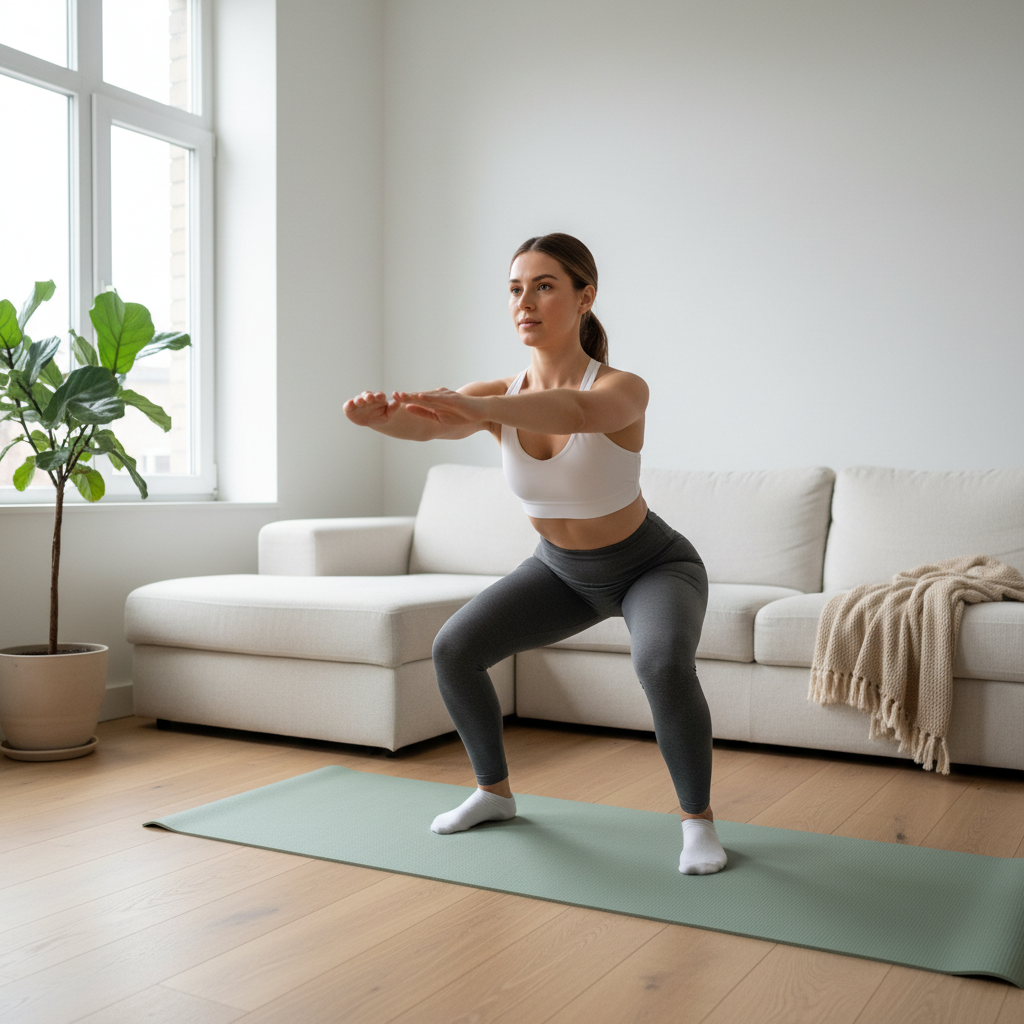
This guide gives you a straightforward weekly plan, a quick self-check to choose the right intensity, and a progression system so you don’t stall after week two. I’ll also point out the common beginner traps that look “motivated” but often backfire.
What a beginner-friendly routine should look like (and why most plans fail)
A workable plan is boring in the best way: repeatable, measurable, and hard to mess up. Most beginner programs fail because they jump to advanced moves, change workouts daily, or treat soreness as a success metric.
- Simple movement patterns: squat, hinge, push, pull, core, carry. You don’t need 30 exercises.
- Recoverable volume: you should finish thinking “I could do a bit more,” not crawling to the shower.
- Clear progression: reps, sets, tempo, or harder variations, not random “more sweat.”
- Built-in consistency: 3–4 days per week is a sweet spot for many beginners.
According to the Centers for Disease Control and Prevention (CDC), adults benefit from both aerobic activity and muscle-strengthening activity each week, so your home plan should include some strength work plus a little cardio, even if it’s short.
Quick self-check: pick the right starting level in 2 minutes
This is the part people skip, then wonder why they either get bored or get hurt. Use these checks to choose how challenging your home training routine should feel during week one.
Use the “talk + reps in reserve” test
- Talk test (cardio): during brisk walking or step-ups, you can speak in short sentences, but you’re not singing.
- Reps in reserve (strength): you stop most sets with about 2–3 reps left in the tank, good form stays intact.
Choose your starting track
- Track A (new or returning): 2 sets per exercise, longer rests, simpler variations.
- Track B (some base): 3 sets per exercise, slightly harder variations, shorter rests.
If you have joint pain, dizziness, a recent injury, are pregnant, or have a medical condition, it’s smart to start conservatively and consider checking with a qualified clinician or trainer for personalized guidance.
The 4-week home training routine (3 days/week) + optional cardio
Keep the exercises the same for four weeks. The novelty comes from progressing reps, tempo, or difficulty. That’s how beginners build skill and strength without overcomplicating it.
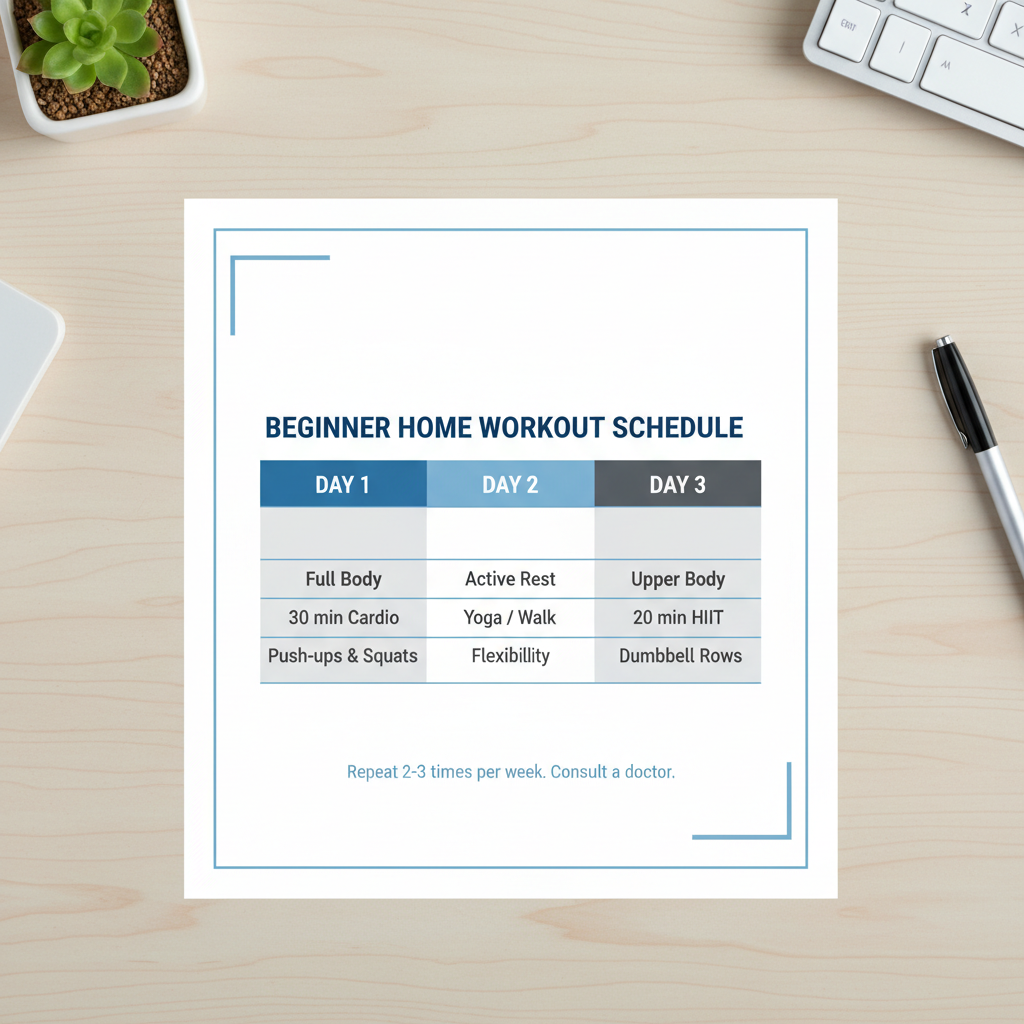
Weekly schedule (repeat for 4 weeks)
| Day | Focus | Time |
|---|---|---|
| Day 1 | Full-body Strength A | 25–40 min |
| Day 2 | Optional Cardio + Mobility | 15–30 min |
| Day 3 | Full-body Strength B | 25–40 min |
| Day 4 | Optional Cardio (easy) | 15–30 min |
| Day 5 | Full-body Strength A (repeat) | 25–40 min |
| Days 6–7 | Rest / walking / light stretching | Flexible |
Warm-up (5 minutes, same each session)
- March in place or easy step-ups: 60 seconds
- Hip hinges (hands on hips, slow): 8 reps
- Arm circles + shoulder rolls: 30 seconds each
- Bodyweight squats to a chair: 8 reps
- Plank on a countertop (or wall): 20–30 seconds
Strength A
- Squat pattern: Chair squat or bodyweight squat, 2–3 sets of 8–12
- Push: Incline push-up (hands on counter/bench), 2–3 sets of 6–12
- Hinge: Hip hinge good-morning (hands crossed on chest) or glute bridge, 2–3 sets of 10–15
- Pull: Towel row (loop towel around a sturdy post) or band row, 2–3 sets of 8–12
- Core: Dead bug or plank, 2–3 sets of 20–40 seconds
Strength B
- Lunge pattern: Reverse lunge (hold a wall for balance), 2–3 sets of 6–10/side
- Push (variation): Kneeling push-up or dumbbell floor press, 2–3 sets of 8–12
- Hinge (variation): Single-leg Romanian deadlift reach (bodyweight), 2–3 sets of 6–10/side
- Pull (variation): Band pull-aparts or one-arm row (dumbbell/backpack), 2–3 sets of 10–15
- Carry: Suitcase carry (one heavy bag), 4–6 trips of 20–40 seconds
Optional cardio (pick one)
- Brisk walk outside
- Stairs or step-ups on a stable step
- Low-impact circuit: march in place, shadow boxing, easy jumping jacks
Keep cardio easy enough that it doesn’t ruin your next strength day. The goal is habit and stamina, not “destroy yourself.”
How to progress each week (without guessing)
This is where a home training routine becomes a plan instead of a random workout. Progression should feel small, almost too easy, until it compounds.
- Week 1: stay conservative, learn technique, stop sets with 2–3 reps left.
- Week 2: add 1–2 reps per set where form stays clean.
- Week 3: add a set to 1–2 exercises, or add light load (backpack, dumbbells).
- Week 4: slow the lowering phase (3 seconds down) on squats/push-ups, keep reps moderate.
If you miss a workout, don’t “make up” by doubling the next day. Just continue the sequence. Consistency beats punishment.
Form cues that keep beginners safe (and actually stronger)
Good form is not about looking perfect, it’s about repeatable positions that your joints tolerate. If something pinches or feels sharp, modify the range of motion or swap the move.
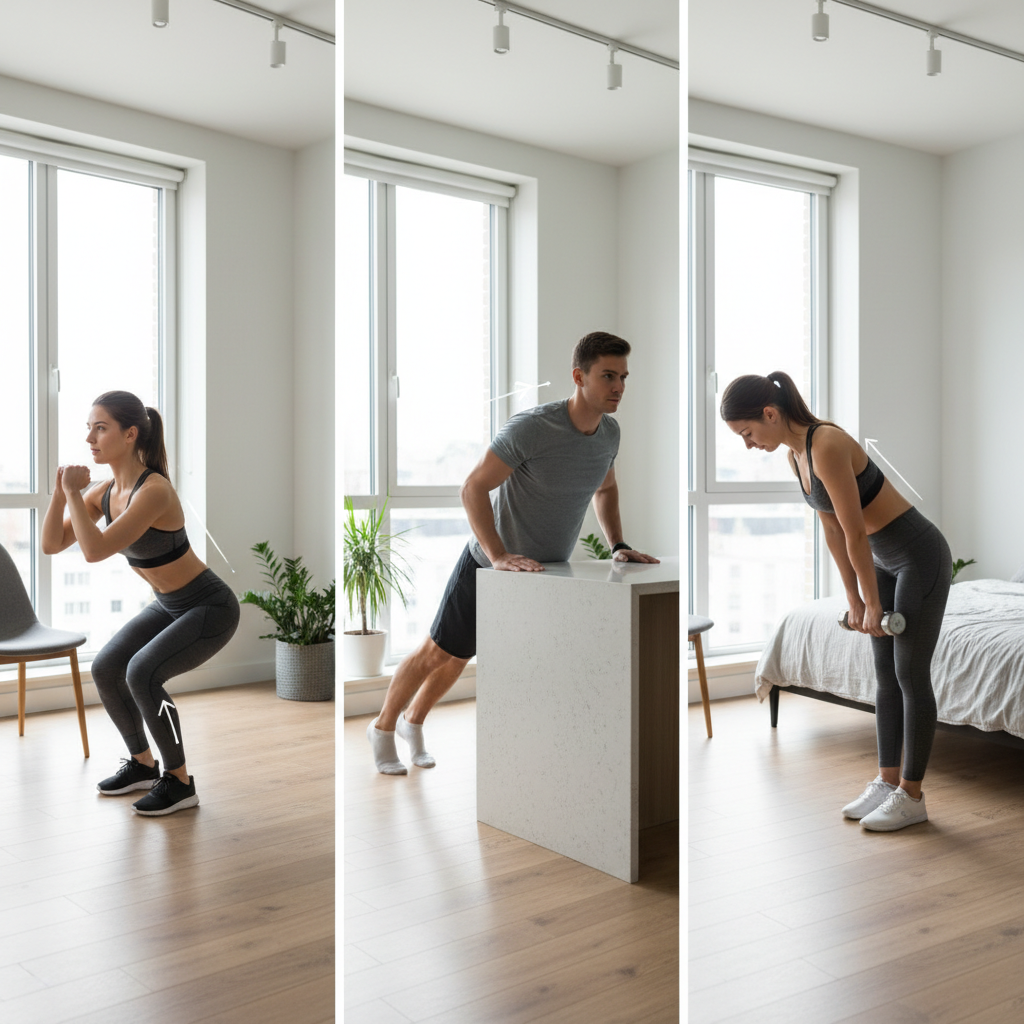
Squat: feet about shoulder-width, knees track roughly over toes, chest stays proud, sit back slightly as if reaching for a chair.
Hip hinge: soft knees, push hips back, spine stays neutral, you should feel hamstrings and glutes doing work more than low back.
Push-ups: body stays like a plank, hands under shoulders, elbows about 30–45 degrees from your torso, stop before shoulders dump forward.
Core work: aim for “ribcage down,” breathe slowly, don’t chase shaking as a badge of honor.
Common mistakes that quietly stall progress
- Going all-out every session: beginners often confuse effort with effectiveness, recovery matters more than people expect.
- Changing exercises constantly: variety feels productive, but repeating moves is how your nervous system learns them.
- Skipping pulling work: lots of home workouts over-focus on push-ups and abs, shoulders often complain later.
- Not tracking anything: you don’t need an app, a note that says “squats 3x10” works.
- Too much too soon with jumps: plyometrics can be great, but many people need a base first, especially if knees or ankles feel sensitive.
According to the American College of Sports Medicine (ACSM), progressive overload is a key principle for improving fitness, meaning your training stimulus needs to gradually increase over time, not swing wildly day to day.
When to adjust, and when to ask for professional help
Some discomfort is normal, especially muscle soreness, but a few signals deserve respect. If any of these show up, scale back and consider professional input.
- Sharp or sudden joint pain, numbness, or tingling
- Pain that worsens across sessions instead of settling within a couple days
- Dizziness, chest pain, unusual shortness of breath beyond typical exertion
- History of injury that flares with specific movements
A physical therapist or certified trainer can often spot simple tweaks that make your home training routine both safer and more effective. If you have a diagnosed condition or take medications that affect heart rate or blood pressure, it’s wise to consult a clinician before pushing intensity.
Key takeaways (save this)
- Repeat the same two strength sessions for four weeks, progress small each week.
- Stop sets with 2–3 reps in reserve until your joints and technique adapt.
- Use optional easy cardio to support health and consistency, not to “burn off” food.
- Track reps and sets so you can improve without guessing.
Conclusion: a simple plan you can actually stick with
If your goal is to start and keep going, simplicity wins. Pick Track A or B, run the plan for four weeks, and let small progress stack up rather than hunting for a perfect program.
Your next step is easy: schedule three sessions on your calendar, set up a tiny workout corner at home, and write down today’s reps. That’s enough to get momentum.
FAQ
How long should a beginner home training routine be each day?
Many beginners do well with 25–40 minutes for strength days. If you only have 15–20 minutes, keep the same exercises and reduce sets, consistency matters more than duration.
Do I need equipment for a home training routine?
No, bodyweight works. A resistance band and a backpack you can load with books often add enough resistance to keep progressing for a while.
Is it normal to be sore after starting home workouts?
Some soreness is common in the first couple weeks, especially after new movements. If soreness makes daily life hard or lasts longer than a few days, reduce volume and intensity.
Can I do this routine if I’m trying to lose weight?
Yes, strength training supports muscle retention, which many people want during fat loss. Weight change still depends heavily on nutrition and overall activity, so consider pairing the plan with daily walking.
What if I can’t do a push-up yet?
Start with incline push-ups on a counter or sturdy table, then lower the incline over time. This keeps the pattern the same while matching your current strength.
How do I know when to increase difficulty?
If you hit the top of the rep range with solid form and still have a couple reps left, add reps next session, then add load or a harder variation once reps feel “too easy.”
Is 5 days a week too much for beginners at home?
It depends on sleep, stress, and how hard sessions feel. Many beginners thrive on 3 strength days plus 1–2 easy cardio days, daily high-intensity work often backfires.
If you’re trying to build a home training routine around limited time, past injuries, or specific goals like running or fat loss, a short customized plan can save trial-and-error and keep you progressing without guessing.