
Workout warm up routine choices matter more than most people want to admit, because the way you start often decides how your first few sets feel, how your joints behave, and whether “tight” turns into “tweaked.”
If you’ve ever walked into the gym, jumped straight under a bar, and spent the next 10 minutes feeling stiff, you’re not alone, it’s a common habit in the U.S. when time feels tight. But the real tradeoff usually shows up later: weaker output, shakier technique, and nagging aches that build week to week.
This guide gives you a full, practical warm-up you can run before most workouts, plus easy ways to adjust for lifting, running, and HIIT. No fluff, just a sequence that covers temperature, mobility, activation, and sport-specific ramp-up so you can start training already “online.”

Why a warm-up changes your workout (and what it should include)
A good warm-up is not just “stretch a little.” It’s a short progression that shifts your body from daily life into training mode, without burning energy you need for the session.
According to the American College of Sports Medicine (ACSM), warm-ups are commonly recommended to prepare the body for more vigorous activity and may help reduce injury risk when paired with sensible training loads.
- Increase temperature: you want warm muscles and a slightly elevated heart rate, not sweat puddles.
- Open usable range of motion: mobility where you need it for today’s lifts or drills.
- Switch on key muscles: glutes, trunk, upper back, and feet/ankles depending on the session.
- Rehearse the pattern: ramp-up sets or strides so the main movement feels familiar.
Static stretching has a place, but many people lean on it as a shortcut. In most gym settings, dynamic movement plus a few targeted holds after training tends to fit better, especially if you’re about to lift heavy or sprint.
Quick self-check: which warm-up do you actually need today?
Before you copy any routine, answer these fast questions. Your warm-up should match your day, not some perfect plan from a video.
- Do you feel “cold” or stiff? If yes, spend longer on general heat and gentle mobility.
- Is today heavy strength or power? If yes, prioritize ramp-up sets and longer rest between them.
- Any cranky joints? Knees, shoulders, low back, ankles, choose 1–2 targeted drills and keep them pain-free.
- How much time do you have? 6 minutes can work, 12 minutes is comfortable, 20 minutes is for very heavy or technical sessions.
- What’s your first exercise? Your warm-up should point directly at it, not wander.
If you’re dealing with sharp pain, numbness, or a history of major injury, it’s smart to keep things conservative and consider guidance from a qualified clinician or coach.
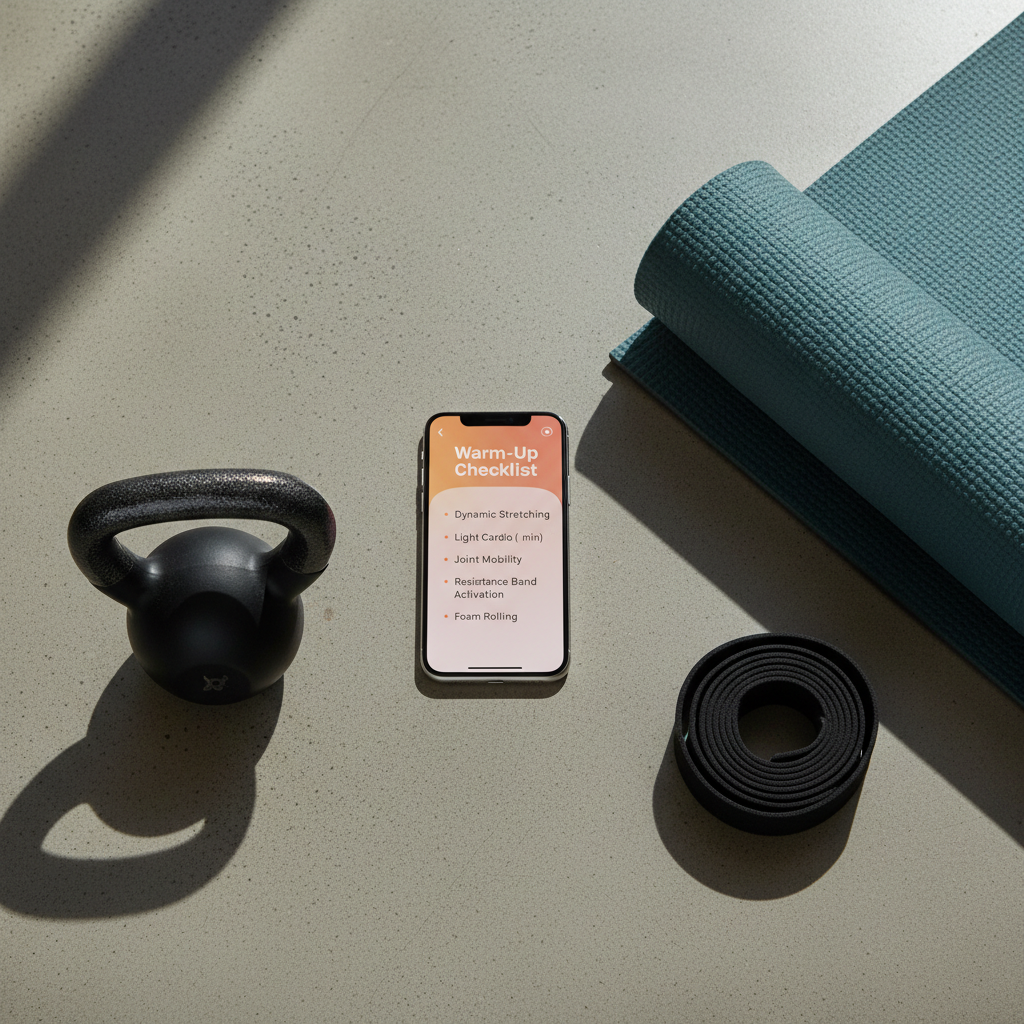
The full warm up routine (10–15 minutes) you can reuse
This workout warm up routine is built as a simple flow: raise temperature, mobilize, activate, then ramp into your first lift or drill. For most people, this hits the sweet spot without dragging on.
Step 1: General heat (3–5 minutes)
Pick one option and keep the intensity easy, you should be able to talk.
- Bike, rower, treadmill incline walk
- Jump rope or light jogging
- Bodyweight flow: marching, easy squats, step-backs
Step 2: Dynamic mobility (3–4 minutes)
Choose 4–6 moves, 5–8 reps each, move smoothly, stop short of pain.
- Hip hinges (hands on hips) + bodyweight good mornings
- World’s greatest stretch (alternate sides)
- Ankle rocks (knee over toes, heel down)
- Thoracic rotations (open books or kneeling rotations)
- Arm circles and cross-body swings
- Deep squat hold with breathing (short, 15–25 seconds)
Step 3: Activation (2–4 minutes)
This is where most rushed warm-ups fall apart. Activation is not “more cardio,” it’s reminding specific muscles to do their job so joints stop taking the hit.
- Glutes: mini-band lateral walks or glute bridges, 8–12 reps
- Core/bracing: dead bug variations or plank reach, 5–8 reps each side
- Upper back: band pull-aparts or face pulls, 10–15 reps
Step 4: Pattern ramp-up (2–6 minutes)
Do 2–5 progressively heavier “practice” sets of your first exercise. Keep reps low, focus on crisp form.
- Example for squat day: empty bar x 8, light load x 5, moderate x 3, then start working sets
- Example for running day: 2–4 strides of 10–20 seconds with easy walking between
Key point: if you only have time for one piece, do general heat plus a couple ramp-up sets. It’s not perfect, but it’s usually more relevant than a long mobility playlist.
Warm-up tweaks by training type (strength, cardio, HIIT)
The same structure works across training styles, but the “center of gravity” changes based on what you’re doing next.
For strength training
- Keep general heat shorter, save time for ramp-up sets.
- If you lift heavy, add an extra ramp set at about 70–85% effort to practice bracing.
- Shoulder days often benefit from more upper-back activation, not more stretching.
For running or field sports
- Spend more time on ankles, calves, hips, then finish with 2–6 strides.
- Keep mobility springy, long static holds right before speed work often feels “off” for many runners.
For HIIT or bootcamp sessions
- Warm up the movement patterns you’ll repeat: squat, hinge, push, pull, rotate.
- Do one short practice round at a low pace, it reduces the “first round shock.”

Common mistakes that make warm-ups feel useless
Most warm-ups fail for boring reasons, not because the idea is wrong.
- Doing random drills: if today is deadlifts, 10 minutes of shoulder mobility probably won’t help much.
- Going too hard too soon: a warm-up that tires you out is just an early workout.
- Skipping ramp-up sets: people “mobility” their way around practice, then wonder why the first set feels heavy.
- Chasing extreme range: forcing depth or stretching into pain can backfire, especially if you’re already irritated.
- Never changing anything: a good workout warm up routine stays consistent in structure, but the drills rotate based on what feels limited.
If a warm-up consistently increases pain, that’s useful feedback. Back off range, change the drill, or swap the movement for the day and consider professional input if it keeps happening.
A simple table you can screenshot (time-based warm-up options)
These options keep the same logic, just compressed or expanded based on your schedule.
| Time | What to do | Best for |
|---|---|---|
| 6–8 min | 2–3 min easy cardio + 2 mobility drills + 2 ramp-up sets | Busy days, moderate sessions |
| 10–15 min | 3–5 min easy cardio + 4–6 mobility drills + 2–3 activation moves + ramp-up sets | Most strength training and mixed workouts |
| 15–20 min | 5 min easy cardio + extra targeted mobility/activation + more gradual ramp-up | Heavy lifting, sprint work, returning after time off |
When to get extra help (and how to stay safe)
Warm-ups can’t solve everything. If you’re repeatedly stuck in the same pain loop, it may be a load-management or technique issue, not a missing stretch.
- Symptoms like sharp pain, instability, swelling, or pain that worsens as you warm up deserve caution.
- If you have a prior surgery, disc issues, or significant joint injury, a physical therapist or qualified coach can tailor drills and progressions.
- According to the Centers for Disease Control and Prevention (CDC), adults benefit from regular physical activity, but it’s reasonable to adjust intensity and seek guidance when health conditions complicate exercise.
When in doubt, keep the warm-up gentle, reduce working weights or intensity that day, and build back gradually.
Conclusion: make your warm-up boring, repeatable, and specific
The best workout warm up routine is the one you actually do, and the one that points straight at today’s session. Keep the structure consistent, heat up, move through the joints you need, switch on key muscles, then ramp into the first lift or drill.
If you want an easy next step, run the 10–15 minute routine for two weeks, then adjust only one variable at a time, usually adding one targeted drill for your most common tight spot.
Key takeaways:
- Warm up for the workout you’re doing today, not the workout you wish you were doing.
- Ramp-up sets or strides often matter more than extra stretching.
- Keep everything pain-free, “working” is fine, “sharp” is not.
FAQ
- How long should a workout warm up routine take?
Most people do well with 10–15 minutes, heavy or technical sessions may need closer to 15–20, and short days can still work with 6–8 if you prioritize ramp-up. - Is stretching before lifting bad?
Not automatically, but long, intense static stretching right before heavy work can feel counterproductive for some people. Many lifters prefer dynamic mobility before, then longer holds after training. - What’s the difference between mobility and activation?
Mobility focuses on usable motion at a joint, activation is about getting specific muscles to contribute. If your knees cave in on squats, activation for glutes and trunk often helps more than “more quad stretching.” - Should I warm up if I’m only doing machines?
Usually yes. Machines reduce balance demands, but tissues still need heat and your first working set still benefits from ramping up. - How do I warm up for leg day when my knees feel achy?
Keep the warm-up gentle, add easy cycling, ankle rocks, and light quad/hamstring activation, then ramp sets with strict form. If pain escalates, consider reducing load and checking with a professional. - What if I always feel tight in my hips?
Try a short hip-focused mobility pair (like world’s greatest stretch and hip hinges) plus glute activation, then see if ramp-up sets feel smoother. If tightness never changes and performance drops, it may be workload, recovery, or technique. - Can I use the same warm-up every day?
You can keep the structure the same, but swap drills based on the session. Repeating the exact same list can work, it just risks missing the areas that actually limit you that day.
If you’re trying to make this more automatic, save the 10–15 minute warm-up as a notes template, then plug in your first exercise and pick 2–3 drills that match it, that small bit of planning often removes the “what do I do?” friction.