
Home fitness routine success usually comes down to one thing: a plan that feels doable on your busiest day, not your most motivated day. If your workouts keep slipping, it’s rarely because you “lack willpower.” More often, the routine is too long, too random, or too hard to start.
This guide builds a daily structure you can repeat, adjust, and actually stick with. You’ll get a plug-and-play weekly framework, short sessions for hectic days, and a simple way to progress without turning your living room into a gym.
One more thing before we get into sets and reps: if you have pain, recent injuries, are pregnant, or manage a medical condition, it’s smart to use a modified plan and consider checking with a qualified clinician or trainer. A good routine should challenge you, not punish you.
What a “daily” home routine really means (and what it doesn’t)
When people search for a daily plan, they often picture intense workouts every day. In practice, a sustainable home fitness routine usually alternates stress and recovery. You can train “daily” by moving every day, while only doing tougher strength sessions a few times per week.
- Daily movement: 10–30 minutes of something, even on busy days (walk, mobility, easy bike).
- Strength days: focused workouts that create progress (2–5 days/week, depending on experience).
- Recovery days: still active, but lighter (mobility, stretching, easy cardio).
According to the Centers for Disease Control and Prevention (CDC), adults generally benefit from a mix of aerobic activity and muscle-strengthening activity across the week. You don’t need perfection here, you need a repeatable baseline.
Why home routines fall apart: the most common real-life blockers
Most routines fail in predictable ways. If you recognize yourself in any of these, you’re not “bad at fitness,” you just need a better system.
- Too much variety, not enough structure: random workouts create decision fatigue, then you skip.
- Sessions are too long: a 60-minute plan looks good on paper and collapses on Monday.
- Progress isn’t measurable: without a simple progression, motivation fades fast.
- All-or-nothing mindset: you miss one day, then the whole week feels “ruined.”
- Environment friction: gear buried in a closet or no clear space means extra excuses.
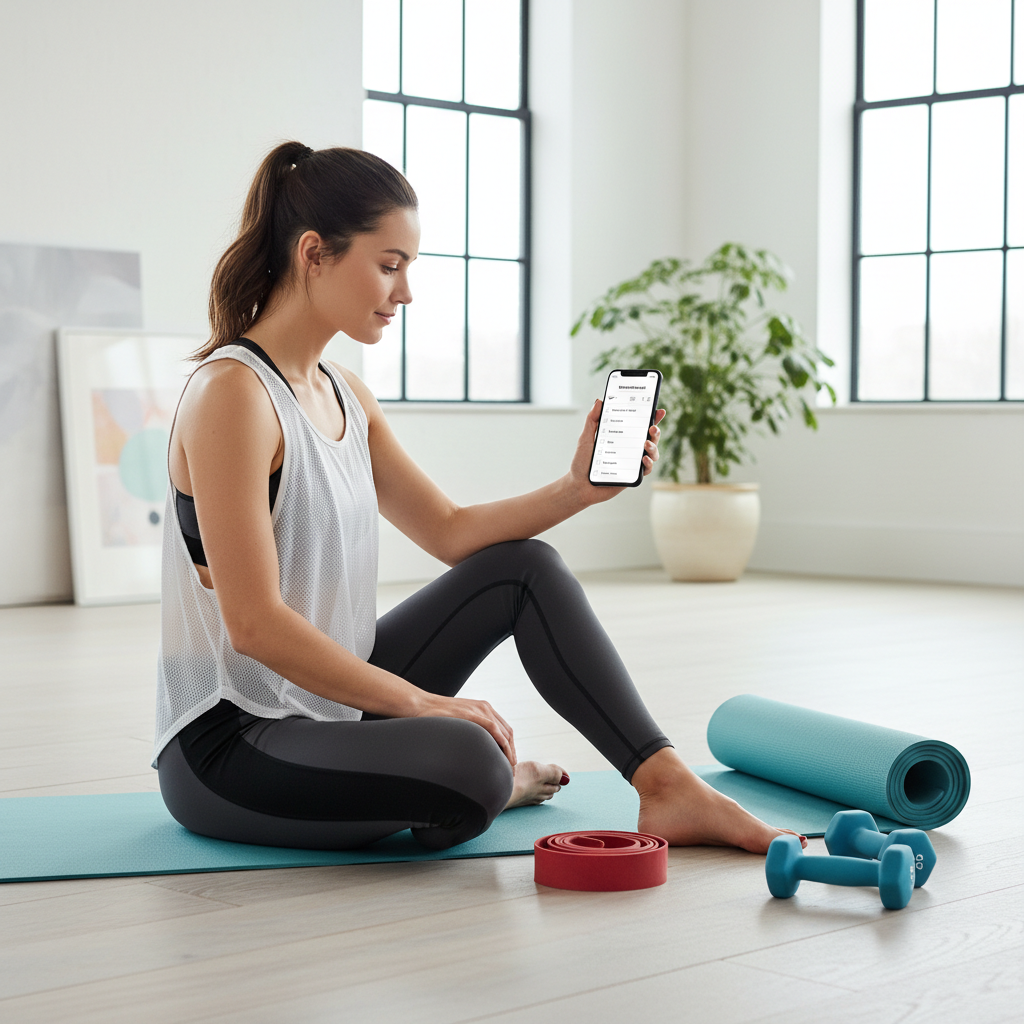
The fix is usually smaller than you think: shorten the default session, repeat a few core workouts, and track one or two numbers that show progress.
Quick self-check: choose the right starting plan
Use this checklist to match the routine to your current reality. If you pick a plan that’s “too advanced,” consistency breaks first, then confidence.
- If you’ve worked out 0–1 days/week recently: start with 3 strength days + daily light movement.
- If you’re consistent but plateaued: keep frequency, improve progression and recovery.
- If joints feel cranky: lower impact cardio, slower tempos, more mobility work.
- If time is the main issue: build around 12–20 minute sessions and a weekend “longer” day.
Safety note: sharp pain, numbness, dizziness, chest pain, or symptoms that feel “off” are reasons to stop and consider medical guidance.
The weekly framework (simple, repeatable, not boring)
This is the backbone. You’ll still “do something” daily, but you only push hard on specific days. Many people do well with this cadence for a home fitness routine because it balances progress with recovery.
7-day template you can repeat
| Day | Focus | Time | Intensity |
|---|---|---|---|
| Mon | Strength A (full body) | 20–35 min | Moderate |
| Tue | Zone 2 cardio + mobility | 20–40 min | Easy |
| Wed | Strength B (full body) | 20–35 min | Moderate |
| Thu | Low-impact conditioning or brisk walk | 15–30 min | Easy–Moderate |
| Fri | Strength A (repeat) | 20–35 min | Moderate |
| Sat | Optional: longer cardio + core | 30–60 min | Easy–Moderate |
| Sun | Recovery: mobility, stretch, easy walk | 10–25 min | Easy |
Key points that make this work
- Two workouts repeated (A and B) beat seven different workouts for most people.
- Easy days protect hard days, so you can train again without feeling wrecked.
- Time caps reduce skipping. Stopping at 30 minutes is a feature.
The actual workouts: Strength A and Strength B (minimal equipment)
You can do these with bodyweight only, but a pair of dumbbells or a resistance band makes progression smoother. Keep rest short enough to stay warm, long enough to keep form clean.
Warm-up (5 minutes)
- 30–60 seconds easy cardio in place (marching, step-ups)
- Hip hinge practice (hands on hips, slow)
- Shoulder circles and scapular squeezes
- Bodyweight squats, slow and controlled
Strength A (full body, 20–35 minutes)
- Squat pattern: goblet squat or bodyweight squat, 3 sets of 8–12
- Push: push-ups (incline if needed) or dumbbell floor press, 3 sets of 6–12
- Pull: one-arm dumbbell row or band row, 3 sets of 8–12
- Hinge: Romanian deadlift (dumbbells) or hip hinge good morning, 2–3 sets of 8–12
- Carry or core: suitcase carry or dead bug, 2–3 rounds
Strength B (full body, 20–35 minutes)
- Lunge pattern: reverse lunges or split squats, 3 sets of 6–10 each side
- Vertical push: dumbbell overhead press or pike push-up, 3 sets of 6–12
- Vertical pull alternative: band lat pulldown or assisted pull-up, 3 sets of 6–12
- Glutes: glute bridge or hip thrust, 2–3 sets of 10–15
- Core: side plank, 2–3 holds each side
How hard should it feel?
A practical rule: finish most sets with about 1–3 reps “in the tank”. If you go to failure every time, recovery becomes the bottleneck, especially at home where sleep and stress vary week to week.
Make it “daily” without burning out: 3 short session options
This is where consistency is won. On days when life gets loud, a short option keeps the streak alive and protects your identity as “someone who trains.”
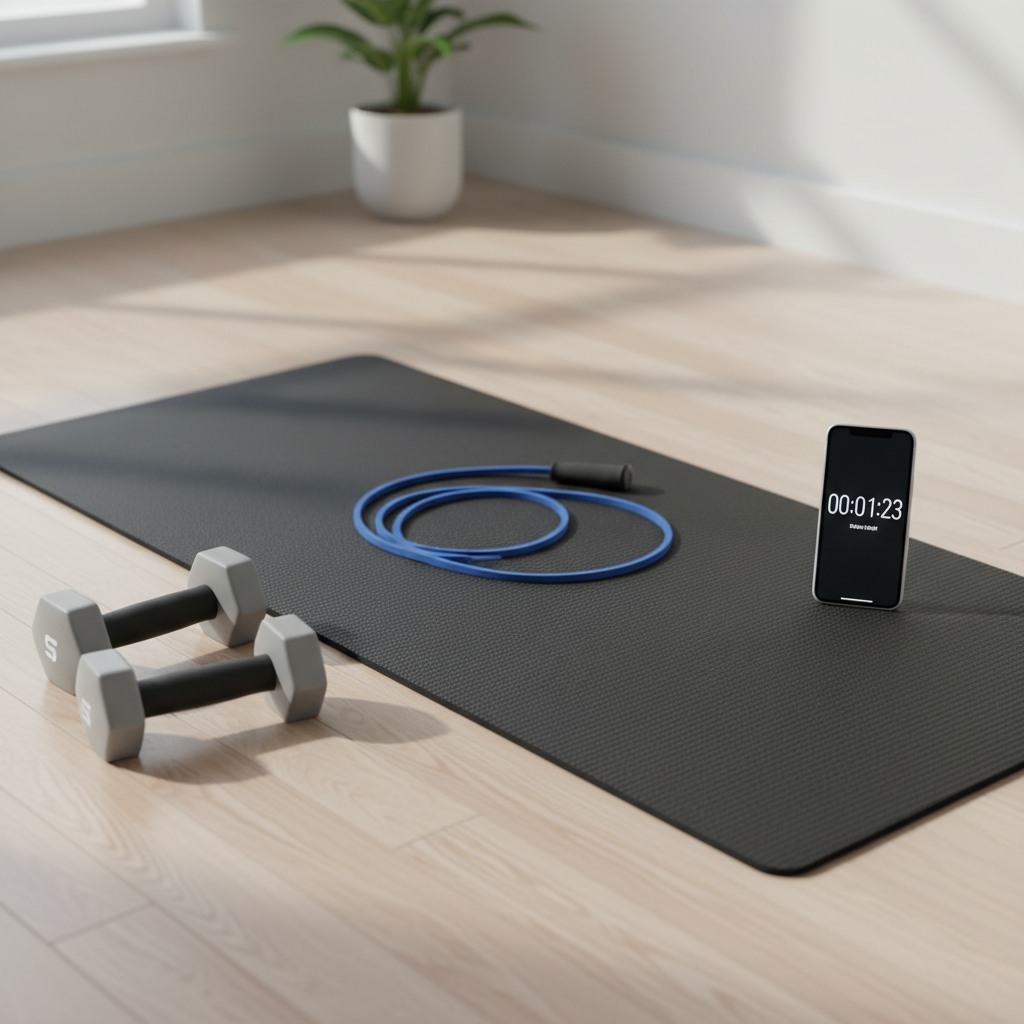
- 12-minute strength snack: 3 rounds of squats, push-ups, rows (30–45 sec each, short rest).
- 15-minute walk + 5-minute mobility: simple, low impact, surprisingly effective for mood and recovery.
- 10-minute core + posture reset: dead bug, side plank, band pull-aparts, easy breathing.
If your goal includes fat loss, these small sessions don’t replace nutrition, but they often reduce the “I fell off” spiral that kills momentum.
Progression: how to keep getting results at home
Progression sounds technical, but it’s really just answering: “How do I make this slightly harder over time?” Without that, a home fitness routine turns into maintenance.
Use one progression method at a time
- Add reps until you hit the top of the range (example: 8 to 12), then add load or difficulty.
- Add load in small jumps (heavier dumbbells, tighter band, slower tempo).
- Add sets only if recovery stays solid and sessions remain time-capped.
- Reduce assistance (lower incline push-ups, deeper squats, stricter form).
Track just a few things
- Exercise, weight used (or variation), reps per set
- Weekly sessions completed
- One subjective note: energy, sleep, or soreness
According to the American College of Sports Medicine (ACSM), progressive overload is a core principle for improving strength and fitness. The “progress” can be modest; it just needs to be consistent.
Common mistakes and safety notes (worth reading once)
- Chasing sweat as the only metric: sweating can reflect temperature and stress, not progress.
- Ignoring pain signals: discomfort from effort differs from joint pain or sharp pain. When in doubt, scale down and seek professional input.
- Going too hard on cardio days: if easy days become hard, strength days suffer and results slow.
- No plan for travel or busy weeks: decide your minimum effective dose ahead of time.
- Copying advanced workouts online: a program built for athletes may not fit your recovery or equipment.
Form tip: if you can’t keep a neutral spine on hinges or you feel shoulder pinching on presses, reduce range of motion, lighten the load, and consider coaching. Small tweaks matter a lot at home.
Practical setup: the “no-excuses” home workout kit
You can do plenty with bodyweight, but a tiny kit makes this easier and more enjoyable. If you’re building slowly, prioritize these in order:
- Yoga mat for comfort and traction
- Resistance bands (loop + long band)
- Adjustable dumbbells or one moderate pair
- Door anchor for pulling variations
- Simple timer (phone works)
Also, pick a “default” spot and keep it visually ready. A mat that’s already out beats a perfect gym corner that takes 10 minutes to set up.
Conclusion: build the routine that survives real life
A workable home fitness routine is less about finding the most creative workout and more about choosing a repeatable weekly structure, then progressing in small steps. If you do Strength A and B consistently, keep easy days truly easy, and track a couple numbers, you’ll usually feel the difference within a few weeks.
If you want a clean starting move, pick your next three training days, schedule them like appointments, and keep the first week intentionally easy. The goal is to prove you can show up, then build from there.
Key takeaways
- Move daily, but only push hard a few days per week.
- Repeat two full-body strength workouts to remove decision fatigue.
- Progress by adding reps, then load, without extending session time.
- Use short options on chaotic days to protect consistency.
FAQ
- What is a good daily home fitness routine for beginners?
Most beginners do well with 3 full-body strength sessions per week plus daily walking and light mobility. Starting lighter than you think helps your joints and consistency. - How long should a home workout be each day?
For many people, 20–35 minutes on strength days and 10–30 minutes on light days is enough to build momentum. Longer sessions can work, but they often become harder to repeat. - Do I need equipment for a home fitness routine?
No, but a band and a pair of dumbbells make progression easier. Without equipment, you can still progress by changing leverage, tempo, and range of motion. - How do I know if I’m overtraining at home?
Common signs include persistent soreness, declining performance, poor sleep, and feeling “wired but tired.” If that shows up, reduce intensity for a week and consider professional guidance if symptoms persist. - Can I do strength training every day?
Some people can, but many do better alternating hard and easy days. Daily heavy lifting often runs into recovery limits, especially with work stress and limited sleep. - What’s the best time of day to work out at home?
The best time is the time you can repeat. Morning works for some because fewer meetings interfere, while evenings work for others as stress relief. - How can I stay motivated working out at home?
Lower the startup friction: keep gear visible, follow a written plan, and use a “minimum session” for busy days. Motivation usually follows consistency, not the other way around.
If you’re trying to build a home plan that fits your schedule, equipment, and any movement limitations, it may help to use a structured program or get a coach to sanity-check your form and progression, so your effort goes into progress rather than guesswork.